I am describing about an animal keep guessing based on the features as described. The animal has four legs, golden furs, a wagging tail, a friendly face. What is this? A cat? I am describing a Golden Retriever dog. Imagine you gave this information to a traditional old school computer. It may get confused that is it a cat or a dog. Older search systems relied heavily on exact word matches. If you searched for "car," they looked for that specific word. Content that used terms like "automobile" or "vehicle" could easily be overlooked even if it contained exactly the information you were looking for. But modern Artificial Intelligence (AI) does not get tripped up by spelling. It understands that a pooch, a canine, and a golden retriever are essentially the exact same concept. How does it do this? It uses a hidden, mathematical playground known as Latent Space.
In the subtopics let's understand deeply what are latent space, why we need it and how AI use them to understand and create the concepts.
Understanding Latent Space
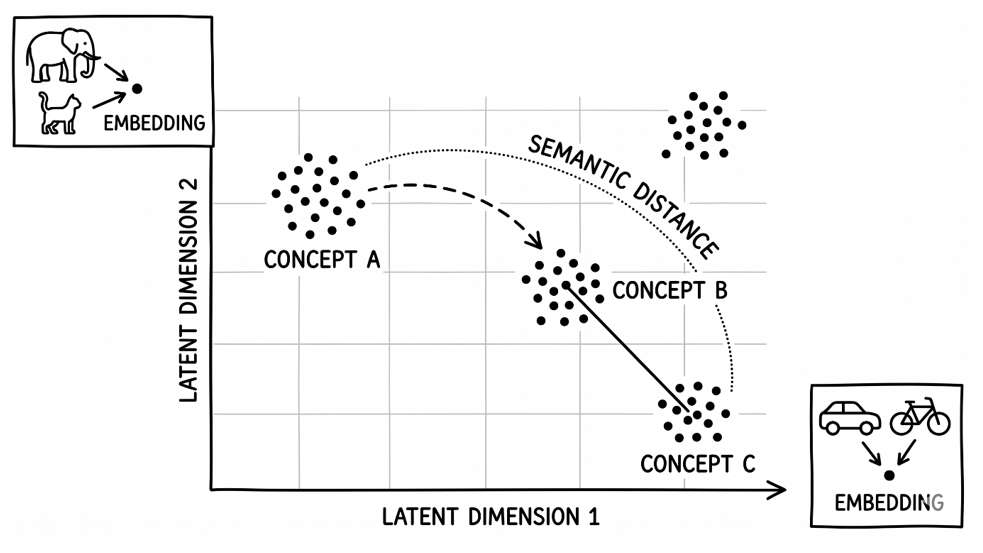
When we search for a location on Google Maps, the map knows all the places where they are located with the help of coordinates. These coordinates act like addresses in a giant map which will help to locate each place. Now let's imagine in place of locations there are words. Similar words are kept nearby and far words are kept apart. For example dog, animal, pet and puppy can be kept together near to each other but dog and laptop will be kept far as there is no similarity between the dog and laptop.
That's what latent space is. It is the hidden map that AI creates to organise the information based on meaning. Just like the map uses coordinates to find locations, AI also uses coordinates in latent space to search for images, words and other form of data. Instead of just two numbers, this AI map uses hundreds or even thousands of independent directions, which scientists call dimensions (D). Each dimension tracks a hidden, abstract characteristic. For words, one dimension might track "How furry is this?", another might track "How mechanical is it?", and a third might track "Is it related to royalty?".
The Real-World Example: The "King - Man + Woman = Queen"
Let's look at a legendary example of how this math works in real life. When an AI processes a word it will translate the word into long list of numbers called an embedding vector. Let's think our AI uses a simple 3-dimensional latent space to track concepts:
| Word | Royality | Masculinity | Has fur |
|---|---|---|---|
| King | 0.99 | 0.93 | 0.01 |
| Man | 0.02 | 0.89 | 0.01 |
| Woman | 0.03 | -0.82 | 0.01 |
| Queen | 0.99 | -0.89 | 0.01 |
Here if you take the coordinates for king, subtract the coordinate of man and add the coordinate for woman, AI will perform arithmetic calculation:
Because the math cancels out the "masculinity" numbers and adds "femininity" while keeping the high "royalty" score, the resulting coordinates land exactly where Queen sits on the map.
Unlocking Unstructured Data
For many years computers could only process structured data things that fit neatly into rows and columns like an Excel spreadsheet of phone numbers or bank balances. Over 80% of the world's information is unstructured data. This includes emails, YouTube videos, voice notes, satellite images, and medical X-rays. A standard database has no idea what to do with a raw picture of a golden retriever puppy. Latent space changes everything. Because deep learning models can convert anything into coordinates. They can map text, sound, and pictures into the exact same grid. If you feed an AI an image of a slice of pizza, it gets a coordinate. If you feed it the text phrase "a cheesy Italian dinner," it gets another coordinate. Because their core meanings match, their locations in latent space end up right next to each other. This is how a music app can recommend song with soothing music when there is rain.
Vector Database
If the AI keeps adding the words into the space where will we keep all of them? When you scale you will get a lot of data (sometimes in high dimensional form like documents) you will get millions of these high dimensional points. If you tried to save these inside a traditional database, the system would crash. Traditional databases are designed to look up exact matches, like sorting a spreadsheet alphabetically. They cannot calculate the complex geometric distances between a million different points in a 1,536-dimensional space. To solve this, software engineers built Vector Databases (like Pinecone, Milvus, and Qdrant). Think of a vector database as a super-smart librarian who reads the "vibe" of every book, rather than looking at its title.
Let's understand the background of how this happens. When you ask a question the database uses a similarity function (usually cosine similarity) to find the closest answers. Instead of measuring a straight line between two points, Cosine Similarity measures the angle (θ) between two vectors pointing from the center of the map. The formula looks like:
If two points are in same direction, then the angle is 0° and the cos(0°) = 1 which means they both are same. If they point in completely opposite directions, the score is -1. This allows the database to find matching concepts in milliseconds.
Getting Deep Down
Till now we have seen what is latent space. The next question is how AI search thought the massive space in fraction of second.
Contrastive Learning
When there is the empty space how AI understands where to keep the things? To do this AI uses a training method called contrastive learning. Contrastive learning uses a mathematical framework called InfoNCE Loss (Information Noise-Contrastive Estimation). In case of positive sample pair, it brings the items closer and in case of negative it penalises and pushes them away.
Through millions of these mathematical pushes and pulls, the latent space naturally organizes itself into clean, logical neighborhoods.
Hierarchical Navigable Small Worlds (HNSW)
If a database contains 100 million vectors, comparing your search query to every single one of them would take forever. To bypass this databases build an index called an HNSW graph.
Imagine you are traveling from Bhubaneswar to Mumbai.
Product Quantization
Storing thousands of precise decimals for billions of items requires a massive amount of expensive computer memory (RAM). To save space we usually use Product Quantization (PQ). Imagine taking a high-resolution 4K photograph of a forest. If you compress it into a smaller JPEG file, you lose a tiny bit of crisp detail on individual leaves, but you can still easily see the trees and paths. PQ does this to vectors. It breaks a massive 1,024-dimensional vector into 16 smaller segments. For each segment, it rounds the numbers off to the nearest generic "codebook" baseline value. This shrinks the size of the data by up to 95% allowing the entire database to run inside blazing-fast system memory at a fraction of the hardware cost.
Research and Future Work
Latent space is no longer just a static filing cabinet rather it has officially transformed into the actual workspace where artificial intelligence carries out its complex reasoning. For years, humans assumed that AI models "think" in the words they type out on our screens. Researchers are now exploring AI architectures that sidestep the constraints of generating text one token at a time. A major survey paper published in 2026, "The Latent Space: Foundation, Evolution, Mechanism, Ability, and Outlook," says about how the backend of the modern AI actually works. It turns out that these systems don't think in words at all instead they do all their heavy lifting the reasoning, the planning, the complex problem-solving in a kind of abstract mathematical space. Language only enters the picture right at the end, when the model needs to actually talk to you.
It's a bit like how you might suddenly just know the answer to a tricky problem before you can quite explain why. The insight arrives whole the words come later.
This same internal logic is also changing how AI systems communicate with each other. They can essentially skip that step entirely exchanging meaning in its raw mathematical form. This machine-native environment has completely rewritten the rules for how AI models talk to one another. At the recent ACL 2026 conference, a historic paper titled "Enabling Agents to Communicate Entirely in Latent Space" by Du et al. introduced Interlat (Inter-agent Latent Space Communication). When two different AI agents needed to collaborate on a tough problem like writing a massive software codebase or predicting stock trends they had to chat back and forth in plain text. This process was incredibly slow, forcing models to down sample rich, high-dimensional internal concepts into discrete words, which often lost vital context along the way. The creators of Interlat designed a way for AI agents to completely bypass human language. Instead of decoding thoughts into text, they transmit the raw, continuous mathematical states from their deepest neural network layers directly to the other agent. When a receiving agent gets a latent transmission
It maps it directly alongside its own input embeddings via a lightweight attention layer:
By directly sharing these hidden states, the machines achieve true digital telepathy. Even better recent research has successfully trained these agents to compress their latent reasoning paths down to just 8 hidden steps. This incredible compression slashes communication latency by up to 24 times while completely preserving the rich context of their digital thoughts. Ultimately, latent space has evolved from a clever mathematical trick used to organize word definitions into the official, native habitat of advanced artificial intelligence. It is a vast, invisible, multidimensional universe where machines don't just mimic human phrases they perceive, remember, plan, and truly build an understanding of our reality.
Conclusion
When we look at the incredible things AI can do today, it's easy to get caught up in the polished text it writes, the beautiful images it generates or the speed with which it answers our questions. But as we have been through this article, we have discovered that the real magic is not happening on our computer screens. It is happening in the quiet, invisible Latent Space.
By breaking down the messiness of human life into organised mathematical coordinates, whether that's our words, our songs, our rough sketches, or even our midnight cravings for spicy chips, AI has done something genuinely remarkable. It has built a bridge between human intuition and machine logic. And with the help of Vector Databases which act as the lightning-fast archives of this new universe, technology can finally understand the "vibe" and true meaning of our world rather than just matching rigid letters and keywords.
We are standing at a wild frontier. As we move into an era where AI agents can reason internally and even use a kind of machine telepathy to collaborate without human words, latent space is no longer just a clever programming shortcut. It has become the native birthplace of machine intelligence.
The next time you type a vague thought into an AI prompt or get a shockingly accurate recommendation on your favourite app, take a moment to picture that massive, invisible map working away in the background. Technology has stopped just reading what we type. It is finally learning to understand what we actually mean.

Aadarsh Senapati
AI enthusiast · Writer · Developer
Bhubaneswar, Odisha, India
Rate This Article
Leave a Comment